Shipwrecked by Belief: A Gnostic Story

When my early life as a fundamentalist minister came to an abrupt and traumatic end, I surveyed what could be salvaged from the general shipwreck of disappointment. A few valuables could be gathered up, for sure; but that old ship would never sail again. Disappointment is an understatement. What is left to believe in when belief itself has betrayed you? We are held captive by belief (ideology, narrative, meme). Manipulation of belief is the basis of mind control, a clear pathway to dystopia.

I spent time in the corporate world. More accurately, I “did” time there. But to survive and thrive aboard the ship of commerce, one must believe without question. “True believers” embrace with total commitment, the paramount importance of production. Quotas and achievements give meaning, purpose, and a direction in life. Scientific materialism produces labour-saving machines and fascinating gadgets which do nothing for the soul. So, with the passage of time, belief falters. “We keep you alive to serve this ship,” the Roman overlord tells the galley slave. I would abandon the ship of commerce to find a new direction.

A man can only stand so much disappointment. I even thought I might become an atheist, but I couldn’t do it. Those who confidently champion scientific materialism, and deny any spiritual reality, are true believers but not true scientists. A true scientist examines the evidence on its merits without pre-conception. No need to review the evidence, they say, we already know the answer. But evidence does exist for a supernatural or paranormal reality. The scientific research of sincere parapsychologists and paranormal investigators is met with derision and ridicule. This is getting much too close to that original experience of belief which tolerates no dissent. The militant atheist has much in common with the religious fanatic.

I graduated from The University of London with a degree in law. Here I began to re-evaluate the fatal attraction of belief. Asking the right question is more important than finding the right answer. Appreciating a good argument is more realistic than an over-abundance of certitude. Adherence to core values of justice, truth and morality are the foundation of natural law. Pursuing what is right, is more important than being right.

Learn to do well; seek judgment, relieve the oppressed, defend the fatherless, plead for the widow. (Isaiah 1)

I discovered Gnosticism by a process of elimination, filtering out that which was reminiscent of my original experience of fundamentalism. Fundamentalism is a mentality, transcending any particular belief system, religious or otherwise. The devil (demiurge) is a shapeshifter. Changing a disguise does not alter the true nature of what lurks beneath the costume. On a good day, the adversary is rigid, inflexible, arrogant, intolerant, argumentative, narrow minded, and contemptuous; on a bad one, unhinged, vicious and violent. The same mental virus infecting the Christian mob which murdered Hypatia of Alexandria also infected the Jacobins of The French Revolution. They believed in extensive government intervention to effect revolutionary social change, in some ways, an early version of Marxism. Thomas Paine was arrested in Paris after he recommended mercy for the royal family. Only an intervention by Thomas Jefferson saved him from the guillotine. A different context yes but the same counterfeiting spirit.

Beliefs are toxic when held tightly. Toxic beliefs thrive on ignorance. Exposure to a wide range of ideas is an effective antidote.

Gnostics believed different things and argued amongst themselves, but that melting pot of ideas uncovered an array of possibilities which could not be known otherwise. When constantly exposed to new ideas which challenge old ones, we avoid the cult of belief. Gnostics hold beliefs lightly. Theirs is a unity of Spirit. Their gnosis (knowledge) is experiential and shamanistic. Beliefs are provisional and subject to change.

A world without belief becomes administratively unworkable. What is there to manage if people are allowed to believe what they want. Authority demands one truth, a narrowing of the imagination. Brute force is clumsy and expensive, better if the masses accept or even demand their servitude.  For this they must believe.

I have also had time to reflect upon all the false beliefs (narratives) we hold about ourselves which, quite apart from those in the world at large, also keep us locked up in a prison for the mind.

This process of calcification drove the Gnostics underground, their wisdom reduced to fragments found in pots. The Library of Alexandria was burned to the ground and with it the natural curiosity of the human mind. If you want to control the world, control the mind.

Paul of Tarsus was once a man of definite belief, a Pharisee of the Pharisees, as he described himself. Early Christians were heretics of Judaism and he participated in their persecution. Paul was later transformed, not by a new belief but by a bolt of lightning, a vision on the road to Damascus, a transformative religious experience (gnosis).

He emerges much less certain about belief.

I am determined not to know anything,

He who thinks he knows, knows nothing yet as he ought to know.

Where there is knowledge, it shall pass away.

 He speaks of that impermeant or provisional knowledge which often fails but not of gnosis, that revelatory experiential knowledge which is transformative and everlasting.

Psychologist Carl Jung, referring to gnosis, says it best: “I do not believe, I know.’

(C) Adrian Charles Smith, 2024
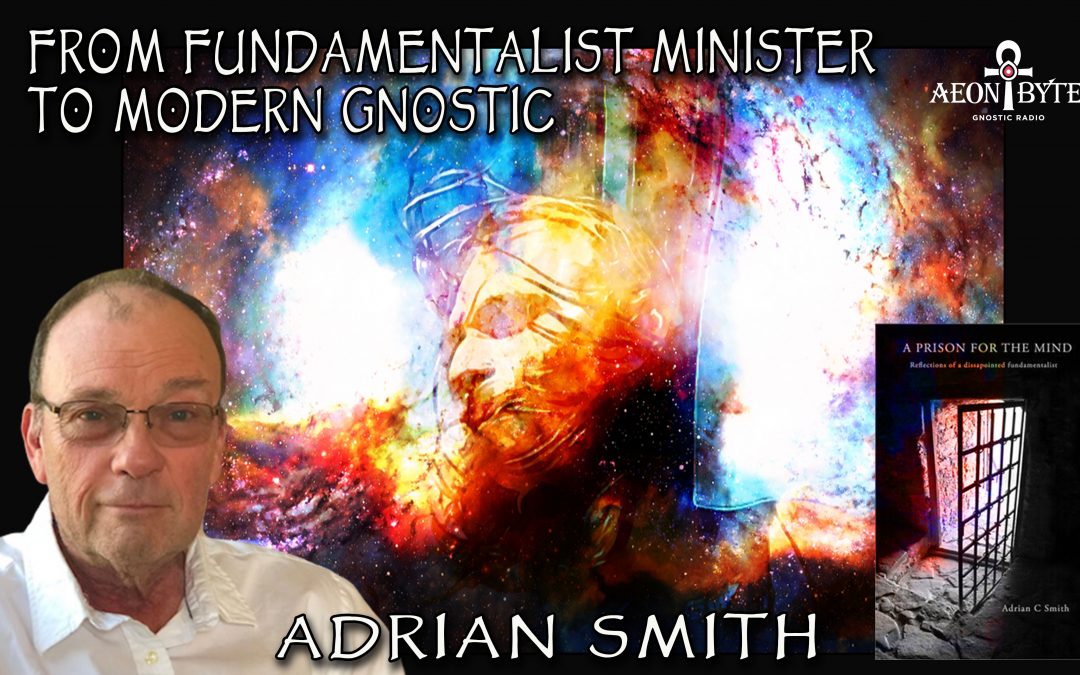
My Book Begins with a Troubling Realization…

matrix
warner bros

Reality might not be what we think it is. What we have come to regard as objectively real might be instead a carefully-constructed false narrative to pull the wool over our eyes. A whole universe of credible alternatives never see the light of day. Our imagination  has been  narrowed, our field of vision confined to a small box  resembling a prison – a prison for the mind. This realization is by no means confined to a religious context but is much more widespread than generally understood. In fact fundamentalism can take over an entire civilization, as outlined in the chapters on postmodernism.  The carefully-constructed false narratives fall apart over time, which leaves us wondering, have we built our house on sinking sand rather than solid rock? We thought we understood the world but the real truth is far different. In the movie The Matrix, the main character Neo, is horrified to discover that his every day world is nothing more than an illusion, a sophisticated mirage. The horrifying truth is that he has lived, since birth, in an incubator where an attached cord siphons off his vital life force energy. The cord is a feeding tube for an alien race of overlords.  They have reduced the human race to an energy source, a collection of living batteries. Immersed in the fantasy of the Matrix, he is unaware of their presence and therefore incapable of escape. The false narratives have a similar effect as the fictional Matrix. If we allow them to continue unchallenged, we can literally fall asleep in delusion. The only answer is to free our minds, to pursue autonomy as though it were the Holy Grail.

I have attempted to distill the essence of fundamentalism, identifying its common features regardless of the external appearances which vary considerably.

Here I summarize some of those common features which are discussed at greater length in the book.

Utopian Vision

If you really believe in utopia, no price is too high and no sacrifice too great to bring it about. The end justifies the means, opening a Pandora’s box of depravity. Like the four horsemen of the apocalypse, famine, pestilence and death ride with them. as illustrated by the Holy Crusades, the Bolshevik Revolution and the Reign of Terror – murder and mayhem, then utopia. But utopia never comes.

The Parasites

These are the ones who benefit from the false narrative.  There’s always a parasite disguised as a benefactor. The old adage applies – follow the money; but their real goal is power, perhaps religious, perhaps political.  Their real motives and objectives remain hidden and often, their very existence.

Demonization of the Opposition

Challenges to the prevailing narrative are not met with argument and reason but rather denunciation and labeling.  This is a form of indirect censorship, not as obvious as book burning to be sure but highly effective. Nothing succeeds quite so well as the smear. The strategy also serves to isolate the believers because they are afraid to listen to or associate with heretics.  Such a reaction is a sure sign you are on the right track. Perhaps they are afraid. Perhaps our liberation is closer than we think. Perhaps we need only snap our fingers to awaken from the trance.  Once we awaken it’s all over for the parasites. Once you realize you’re in a cult you’re already free.

The Mask of Piety

The parasites always manage to occupy the moral high-ground.  This has been true since the Pharisees and no doubt longer than that. Outwardly, they appear righteous but inwardly they are full of corruption. They like to make public displays of piety which in modern times has been called “virtue signalling.” Beneath the veneer of moral and intellectual superiority there exists a barely concealed contempt for the vulgar masses.

Hypocrisy

Invariably, the evidence mounts that the parasites do not practise what they preach, yet the true believers remain unwavering in their loyalty.  This represents, I believe, a kind of wilful ignorance.  The desire to believe is so strong that even when the hypocrisy becomes truly staggering, continuation of the status quo is preferred to the discomfort of uncertainty.

Arrogance

All fundamentalists have a certain contempt for unbelievers. This can range from mild condescension as in “let’s reach out to save the poor lost souls” or all the way to mass murder, as in, “let’s get rid of this evil  in the world.”  The Crusaders had this in mind as did Stalin and Hitler.

This arrogance has an addictive quality because it gives the true believer a false sense of empowerment.  The addict is attempting to relieve his suffering which in this case is a sense of disempowerment.   The fundamentalist is part of a special people, an elect. The elect know “the truth”, others do not.  There is a feel-good factor here but because every drug starts to wear off,  more is needed to have the same effect.  Every addict is blind to his addiction so if it isn’t working, his answer is – “double down.”  If the addict were not blind he would reach the obvious conclusion: the ideology isn’t working anymore because there’s something wrong with it.

Shadow Projection

Psychologist Carl Jung and others have long argued that we all have a shadow side, those attributes which we would prefer to keep secret. The dividing line between good and evil runs through the centre of each individual soul. But for the fundamentalist, the dividing line exists at the boundaries of his ideology.  All virtue is ascribed to those who belong to the inner circle and all evil to those who do not.

Shadow denial leads to shadow projection. Those attributes which we reject within ourselves are projected onto others, the non-believer or the heretic. The deeper the denial the more fanatical the projection.  The true believer starts to resemble the very thing he hates. Those who profess tolerance are plagued by intolerance.  Those who profess virtue are a veritable grab-bag of sin.  This can reach hysterical proportions as it did during the Salem witch trials where innocent women were hanged. To see a modern day example of this hysteria and mob mentality see the video What’s Happening at Yale?  

Every human being has a shadow and so does every ideology, a combination of both positive and negative attributes. The shadow loses its sting once recognized and integrated into wholeness. The concept of integration is the vital antidote to fundamentalism. Integration at the individual level yields an integration of various competing ideologies. Every ideology has something to contribute. It ossifies if mistaken for the whole truth.

Adrian Charles Smith, December 2019