Join Adrian Smith, Miguel Conner and Gram Pong for this presentation entitled “Breaking Free from Mind Control”, featured on the Aeon Byte Youtube channel.
An inspiring discussion with Taoist priest and master, San Qing, creator of Consciousness of the Way 126podcast and YouTube channel. We explore the Gnostic path and similarities with Taoist practice and tradition.
When my early life as a fundamentalist minister came to an abrupt and traumatic end, I surveyed what could be salvaged from the general shipwreck of disappointment. A few valuables could be gathered up, for sure; but that old ship would never sail again. Disappointment is an understatement. What is left to believe in when belief itself has betrayed you? We are held captive by belief (ideology, narrative, meme). Manipulation of belief is the basis of mind control, a clear pathway to dystopia.
I spent time in the corporate world. More accurately, I “did” time there. But to survive and thrive aboard the ship of commerce, one must believe without question. “True believers” embrace with total commitment, the paramount importance of production. Quotas and achievements give meaning, purpose, and a direction in life. Scientific materialism produces labour-saving machines and fascinating gadgets which do nothing for the soul. So, with the passage of time, belief falters. “We keep you alive to serve this ship,” the Roman overlord tells the galley slave. I would abandon the ship of commerce to find a new direction.
A man can only stand so much disappointment. I even thought I might become an atheist, but I couldn’t do it. Those who confidently champion scientific materialism, and deny any spiritual reality, are true believers but not true scientists. A true scientist examines the evidence on its merits without pre-conception. No need to review the evidence, they say, we already know the answer. But evidence does exist for a supernatural or paranormal reality. The scientific research of sincere parapsychologists and paranormal investigators is met with derision and ridicule. This is getting much too close to that original experience of belief which tolerates no dissent. The militant atheist has much in common with the religious fanatic.
I graduated from The University of London with a degree in law. Here I began to re-evaluate the fatal attraction of belief. Asking the right question is more important than finding the right answer. Appreciating a good argument is more realistic than an over-abundance of certitude. Adherence to core values of justice, truth and morality are the foundation of natural law. Pursuing what is right, is more important than being right.
Learn to do well; seek judgment, relieve the oppressed, defend the fatherless, plead for the widow. (Isaiah 1)
I discovered Gnosticism by a process of elimination, filtering out that which was reminiscent of my original experience of fundamentalism. Fundamentalism is a mentality, transcending any particular belief system, religious or otherwise. The devil (demiurge) is a shapeshifter. Changing a disguise does not alter the true nature of what lurks beneath the costume. On a good day, the adversary is rigid, inflexible, arrogant, intolerant, argumentative, narrow minded, and contemptuous; on a bad one, unhinged, vicious and violent. The same mental virus infecting the Christian mob which murdered Hypatia of Alexandria also infected the Jacobins of The French Revolution. They believed in extensive government intervention to effect revolutionary social change, in some ways, an early version of Marxism. Thomas Paine was arrested in Paris after he recommended mercy for the royal family. Only an intervention by Thomas Jefferson saved him from the guillotine. A different context yes but the same counterfeiting spirit.
Beliefs are toxic when held tightly. Toxic beliefs thrive on ignorance. Exposure to a wide range of ideas is an effective antidote.
Gnostics believed different things and argued amongst themselves, but that melting pot of ideas uncovered an array of possibilities which could not be known otherwise. When constantly exposed to new ideas which challenge old ones, we avoid the cult of belief. Gnostics hold beliefs lightly. Theirs is a unity of Spirit. Their gnosis (knowledge) is experiential and shamanistic. Beliefs are provisional and subject to change.
A world without belief becomes administratively unworkable. What is there to manage if people are allowed to believe what they want. Authority demands one truth, a narrowing of the imagination. Brute force is clumsy and expensive, better if the masses accept or even demand their servitude. For this they must believe.
I have also had time to reflect upon all the false beliefs (narratives) we hold about ourselves which, quite apart from those in the world at large, also keep us locked up in a prison for the mind.
This process of calcification drove the Gnostics underground, their wisdom reduced to fragments found in pots. The Library of Alexandria was burned to the ground and with it the natural curiosity of the human mind. If you want to control the world, control the mind.
Paul of Tarsus was once a man of definite belief, a Pharisee of the Pharisees, as he described himself. Early Christians were heretics of Judaism and he participated in their persecution. Paul was later transformed, not by a new belief but by a bolt of lightning, a vision on the road to Damascus, a transformative religious experience (gnosis).
He emerges much less certain about belief.
I am determined not to know anything,
He who thinks he knows, knows nothing yet as he ought to know.
Where there is knowledge, it shall pass away.
He speaks of that impermeant or provisional knowledge which often fails but not of gnosis, that revelatory experiential knowledge which is transformative and everlasting.
Psychologist Carl Jung, referring to gnosis, says it best: “I do not believe, I know.’
Further to my presentations on Canada’s truckers’ protest, delivered at The Glastonbury Symposium and on Aeon Byte, there has been an important new development. The Federal Court of Canada has just decided that Trudeau’s invocation of the Emergencies Act 1988, was unconstitutional, illegal and unreasonable.
This contrasts with the prior determination of Justice Paul Rouleau, Chairman of The Public Order Emergencies Commission, a public inquiry into the circumstances leading up to invocation of the EA and subsequent freezing of bank accounts and martial law responses.
The important distinction here is that Justice Rouleau was a political appointee charged with rendering an “opinion” at the end of the inquiry. Justice Rouleau’s “opinion” was that the very high standards of the EA were met. In his remarks, Justice Rouleau emphasized that his “opinion” did not have the force of law and that a final determination was a matter for the courts. This recent decision of the Federal Court, on the other hand, does have the force of law and of legal precedence, opening the way for further lawsuits against the government by all those harmed by invocation.
In his remarks more than a year ago, Justice Rouleau also stated that he arrived at his “opinion” reluctantly as it was “not strongly supported by the facts” and that a reasonable person, properly informed, could easily reach a different conclusion. A compliant media dutifully reported the headline “opinion” without reporting his follow-on remarks, so the government appeared to be in the clear; that is, until now.
If granted leave to appeal, the Trudeau Government will go to the Supreme Court, but government lawyers will have a very steep hill to climb.
Having followed this protest closely for over two years, I now believe we have two different legal systems at odds with each other — one based on established principles and the other clearly politicized. The latter is prepared to ignore “facts” or redefine language to support government policy.
It has been accepted for centuries that a “balance and separation of powers” is the basis of a free society. No one organ of governance (legislative, judicial, executive) should be allowed to dominate the others. In our system, even the police exercise an independent authority. So, when judges make decisions which ignore facts to protect the powerful, we are in grave danger.
“Facts,” said, John Adams, “are stubborn things.” It has been two years now since the protest but those stubborn facts, though suppressed, have not gone away.
We stand on the precipice but have stepped back from the edge, at least for now.
Here is my presentation this past summer at The Glastonbury Symposium, the UK’s largest alternative conference, recorded at the Town Hall, Glastonbury, Somerset, in July 2023.
My interview with Miguel Connor of Aeon Byte Gnostic Radio, home of the virtual Alexandria (see recommended section). This is a doubleheader with Sean Stone, son of filmmaker Oliver Stone, well known for such classic films as JFK and Born on The Fourth of July. We discuss Sean’s latest documentary, Best Kept Secret, a powerful expose, speaking truth to power. I have included a link to the documentary in the Media Section.
The interview continues, examining those forces which control our “reality”.
We discuss fundamentalism as a fractal pattern permeating our institutions.
Dr. Cyd Ropp, PhD, is an author, speaker, and a Gnostic sage of the first order. She holds degrees in Psychology, Education, Counseling and a PhD in Classical Rhetoric (the study of ancient manuscripts). Her papers, published in both academic and popular journals, have won many awards, and she taught at university for six years before launching her own career as a writer and podcaster. Her vision of individual units of consciousness nested in in a sea of universal consciousness is one which I share, and her commentary on fractal patterns caught my eye because I too use fractal imagery in my writing. I highly recommend Cyd’s books and podcasts.
Audio courtesy Cyd Ropp
Cyd’s two insightful blogs can be found through the below links:
I have the pleasure of being joined in the Zoom Room by New Testament scholar Steve Seven. Steve is a prolific author, a psychotherapist, a mythologist and an expert on the psychology of both Freud and Jung. You can find out more about Steve at https://spiritualinstinctpress.com/.
In both Part 1 and Part 2 we discuss “Defeating the Archons”.
In Part 1 we define terms. Who (what) are the archons, the Elohim, demons and daemons, gods and angels. How does archontic influence play itself out in the physical realm? We discuss possible solutions, such as “parallel structures” and community-based governance operating within and alongside the empire of the archons.
In Part 2 we discuss deception programs, the importance of multiple sources of information, the quest for autonomy, the importance of inner work as an indirect strategy influencing the outer world.
Ancient prophecies point to a time when the sacred will not be honoured, accepted, or believed in, thus generating chaos in a world “bereft of the presence of its deities” (Hermes). Materialism fills the spiritual void, causing disintegration, deception, crime, war, and environmental degradation. Their idols are their possessions, and their magic is technology; “they worship the work of their own hands” with no reverence for the mystery and wonder of the Cosmos. The earth, with all its resources, is considered mere pre-production inventory, not a living presence or animating goddess (Sophia), worthy of reverence. Science and technology reinforce the paramount importance of production—we all have our parts to play, so that we might feel successful and receive approval, fulfilling our purpose as cogs in the great wheel of materialism. In the end, having done our duty, we are discarded like so many worn-out parts, no longer fulfilling any purpose or function.
In the tragic/comedy film “About Schmidt” a sense of emptiness in Schmidt’s retirement leads him to re-visit the office to see if he can be “useful.” Once there, he finds his entire life’s work neatly packed in cardboard boxes on its way to the incinerator, as a new generation of middle management finds a better way. No, it really isn’t pretty what a world without pity can do.
As well as offering the only life worth living, the religion of scientific materialism even promises a kind of technological immortality, called, “transhumanism,” a vain belief which ignores an immutable law of the universe—entropy. Everything returns to dust, even the most sophisticated artificial life form.
And this leads me to the prophecies of the thrice great (Thoth) Hermes as delivered to his pupil, Asclepius, in the Hermetica:
Do you not know, Asclepius, that Egypt is an image of heaven, or, to speak more exactly, in Egypt all the operations of the powers which rule and work in heaven have been transferred to earth below?
Nay, it should rather be said that the whole Cosmos dwells in this our land as in its sanctuary. And yet, since it is fitting that wise men should have knowledge of all events before they come to pass, you must not be left in ignorance of this: there will come a time when it will be seen that in vain have the Egyptians honoured the deity with heartfelt piety and assiduous service; and all our holy worship will be found bootless and ineffectual. For the gods will return from earth to heaven; Egypt will be forsaken, and the land which was once the home of religion will be left desolate, bereft of the presence of its deities.
0 Egypt, Egypt, of thy religion nothing will remain but an empty tale, which thine own children in time to come will not believe; nothing will be left but graven words, and only the stones will tell of thy piety.
Darkness will be preferred to light, and death will be thought more profitable than life; no one will raise his eyes to heaven; the pious will be deemed insane, and the impious wise; the madman will be thought a brave man, and the wicked will be esteemed as good. As to the soul, and the belief that it is immortal by nature, or may hope to attain to immortality, as I have taught you, all this they will mock at, and will even persuade themselves that it is false. No word of reverence or piety, no utterance worthy of heaven and of the gods of heaven, will be heard or believed.
And so the gods will depart from mankind, a grievous thing!, and only evil angels will remain, who will mingle with men, and drive the poor wretches by main force into all manner of reckless crime, into wars, and robberies, and frauds, and all things hostile to the nature of the soul.
Yet, Hermes foresees an end to this Matrix and an escape from this “desert of the real” by a dramatic re-ordering of all things, “a new heavens and a new earth” as predicted in the Book of Revelation. Hermes calls it a “new birth of the Cosmos”:
But when all this has befallen, Asclepius, then the Master and Father, God, the first before all, the maker of that god who first came into being, will look on that which has come to pass, and will stay the disorder by the counterworking of his will, which is the good. He will call back to the right path those who have gone astray; he will cleanse the world from evil, now washing it away with waterfloods, now burning it out with fiercest fire, or again expelling it by war and pestilence. And thus he will bring back his world toits former aspect, so that the Cosmos will once more be deemed worthy of worship and wondering reverence, and God, the maker and restorer of the mighty fabric, will be adored by the men of that day with unceasing hymns of praise and blessing. Such is the new birth of the Cosmos; it is a making again of all things good, a holy and awe-striking restoration of all nature; and it is wrought in the process of time by the eternal will of God. For Gods will has no beginning; it is ever the same, and as it now is, even so it has ever been, without beginning. For it is the very being of God to purpose good.
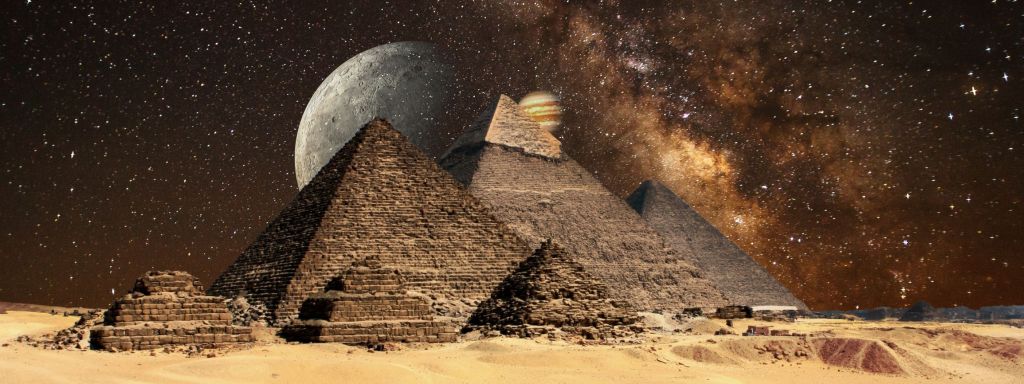
In all corners of the globe, the remnants of ancient civilizations, much older and more advanced than previously known, speak of a piety and reverence for nature and connection to Spirit, which is almost incomprehensible to the modern mind. It is as though they occupied a parallel universe, one viewed by them in a manner which we can barely understand. From the Great Pyramid of Giza to the living stones of Sacsayhuamán, their piety is written in the stones, some weighing 350 tonnes and placed with a precision that modern science has great difficulty explaining; and all this to honour the sacred and the divine. The production and consumption of endless “stuff” did not interest them; the cycles of the heavens and communion with Spirit did. For them, the veil between dimensions was thin.
In Cuzco, Peru, in 1589, Don Mancio Serra de Leguizamo — one of the last survivors of the original conquerors of Peru—wrote in the preamble of his will, the following:
“We found these kingdoms in such good order, and the said Incas governed them in such wise [manner] that throughout them there was not a thief, nor a vicious man, nor an adulteress, nor was a bad woman admitted among them, nor were there immoral people. The men had honest and useful occupations. The lands, forests, mines, pastures, houses and all kinds of products were regulated and distributed in such sort that each one knew his property without any other person seizing it or occupying it, nor were there lawsuits respecting it… the motive which obliges me to make this statement is the discharge of my conscience, as I find myself guilty. For we have destroyed by our evil example, the people who had such a government as was enjoyed by these natives.”
Leguizamo left all his worldly goods to help the Inca people.
Not all the New World was found in this condition, where indeed some tribes worshipped cruel gods demanding human sacrifice, but this was no more the whole story of indigenous culture than conquest and exploitation is the whole story of European civilization. Every civilization, every tribe and every individual has a dark side or shadow, and in fact, the brighter the light the darker the shadow. Perhaps “the new birth” will be a coming together of all the tribes of the earth, the contribution of each elevating the whole.
And it shall come to pass in the last days, that the mountain of the Lord’s house shall be established in the top of the mountains and shall be exalted above the hills; and all nations shall flow unto it.
And many people shall go and say, come ye, and let us go up to the mountain of the Lord, to the house of the God of Jacob; and he will teach us of his ways, and we will walk in his paths: for out of Zion shall go forth the law, and the word of the Lord from Jerusalem.
And he shall judge among the nations and shall rebuke many people: and they shall beat their swords into plowshares, and their spears into pruninghooks: nation shall not lift up sword against nation, neither shall they learn war anymore.(Isaiah 2)
The Hopi Indians had a word in their prophecies for a world of consumer driven madness, devoid of Spirit. They called it Koyaanisqatsi. Koyannis means “corrupted” or “chaotic” and the word qatsi means “life” or “existence.” The Hopi called it “crazy life” or “life out of balance.” A documentary film of the same name presents this concept in artistic form and can be accessed by using the link below. The film helps us to visualize ourselves encased in an artificial environment that has replaced the original. Nature is only a resource to keep the artificial world alive.
If we dig precious things from the earth, we will invite disaster (Hopi prophecy)
It is Friday, April 2, in the year of our demiurge 2021, a Good Friday, as fate would have it. My wife and I have finished a meal of fish chowder and I am feeling good, except for a mild discomfort in my abdomen. The discomfort grows to an acute pain extending in an ever-tightening band from front to back. Sometimes the pain subsides, only to come back like the turning of the screw.
Hours go by without relief. I try numerous remedies, including extra-strength pain killers, but nothing helps. After 24 hours of increasing and unbearable pain and no sleep, I surrender to the inevitable and we call an ambulance. I know that a blocked bowel can be life threatening and that sometimes cancer causes the blockage. The bumpy road to the hospital provokes heavy vomiting and I feel better for a while but the pain soon returns.
At the hospital I am given morphine. Two nurses appear and, through the nose, insert a tube into my stomach. The tube won’t go through the nasal passage, causing even more pain. They tell me how sorry they are as they push harder, switching from one nostril to the other. I am moved by their compassion and their courage to do what is needed, however difficult.
One more night without sleep, this time in a hectic, well-lit and bustling triage area. In the morning a surgeon appears, a black African of kindly disposition, notifying me of impending surgery. He tells me I am garnering a reputation in the hospital as a real troublemaker. I burst out laughing. I can still laugh. That’s good! Where there is laughter there is hope.
As I revive from surgery, that same kindly voice is telling me that no blockage was found despite the CAT scan results clearly identifying one. The surgery had been, in that event, only exploratory, a far less invasive procedure. I would next be given a camera pill to swallow, which will, in theory, work its way to the blockage and then stop, all the while transmitting images to technicians.
It is Saturday, April 3, and I am transferred from triage to the main hospital, a shared room with three other patients. Sitting up in a bed across from me is the perfect image of General George Armstrong Custer. When Custer speaks, which is often, his voice carries halfway across the ward. He plays loud movies on his entertainment system and keeps complaining that he has no access to the Disney Channel. He constantly asks the nurses for help, but none of them are able to solve his technical problems.
Custer is in a really bad way, something he does not seem to realize. He gets in loud arguments with his wife and sons about when he is going home, but he requires 24-hour attention. His wife tells him, “I am really stressed out about it” but he keeps on minimizing the situation. He will live in the garage to avoid the stairs, he says. His wife starts to leave, wishing him good night. He starts talking again and she says good night one last time. The phone rings and it’s number one son. “Your mom’s mad at me,” Custer says. “She stormed out — didn’t even say good night!”
Custer plays his 3AM movies at full volume. The nurses tell him to turn it down. “I can’t hear anything,” he says. “Well, use earphones then!” Custer never surrenders. “They hurt my ears,” he responds.
So this is what it’s like, I find myself thinking, this descent into the underworld. I can’t sleep, I can’t eat or drink and if I bend my arm it sets off an alarm on the IV machine. All I can do is observe. I think of holocaust survivor Viktor Frankl. Everything is taken away from you, he says, except one thing — the power to choose your state of mind. I close my eyes and let the situation be what it is.
My throat is sore and my mouth so dry I can barely speak, so the nurse brings me a cup of crushed ice, which I must administer sparingly to avoid the ‘no fluids’ order. I am amazed at how much joy can be derived from a few pieces of crushed ice.
A young nurse visits me frequently, always asking, when she leaves, “Is there anything I can get for you?” I know there is nothing she can get for me and she knows it too but it’s her way of saying I care, I want to help. She has an elaborate tattoo on her forearm and hand, a pink and yellow floral pattern interlaced with light green vines. I come from a generation where tattoos were for merchant seaman and dockworkers, the flotsam and jetsam of the high seas, those who frequented seedy, smoky waterfront bars in Halifax or Saint John. I could never understand why anyone would want a tattoo, least of all a young woman; but barely visible amongst the vines on her arm is this powerful word — LOVE. I am moved almost to tears. I could tell this gentle soul was born for this line of work. Her every instinct was only to help, to make things better.
How good it is to be wrong! Being right is so dreadfully overrated. How pleasant to observe one more foolish prejudice burned in the crucible of my own experience, this silly thing about women and tattoos. Being wrong can be liberating when it frees the slave from his own stupid opinion. Our capacity to get things wrong is simply enormous.
Saint Paul was chastened by his vision to not call anything clean or unclean. In his former life as a Pharisee of the Pharisees, he had been full of judgments and definite opinions.
I’m beginning to see gnosis as the end product of a process of refinement, the burning away of false judgments, erroneous thinking, and miscalculations to arrive at the pearl of great price.
I have had my bellyful of thinking I’m right, and old Custer is driving this home for me. I reflect upon the various Custer decisions of my life, and the lengthy postmortems in the wake of them. What’s the point of being right if it does nothing for the advancement of your own soul? Surely this is gnosis — nothing to do with correct doctrine. Gnosis is an epiphany. It moves you to your core. Who cares about being right or wrong?
An amazing thing happens after midnight on Saturday. The camera which is supposed to get stuck does not, completes its run without incident. On Sunday morning the order comes through: I may resume eating and drinking. Roxanne arrives later with a care package. It’s now Sunday. There will be more time in the hospital for observation, but the crisis is ending.
The surgeon tells me they do not know what caused my problem. There was no mistaking the CAT scan and blocked bowels do not unblock themselves, he tells me.
So there it is, three days and three nights in the belly of the whale, disgorged (discharged) at last – exhausted, chastened, but renewed. Could this be a metaphor for life itself? Our life’s experience exhibits an intelligence all its own, almost like a dream, full of hidden meaning. We have strayed too far from the centre of things, to a place of confusion and suffering, and now we are finding our way home aided by the deepest levels of the unconscious.
Hardly the Easter celebration I had in mind, but I emerge the better for it.