Integrating Opposites II
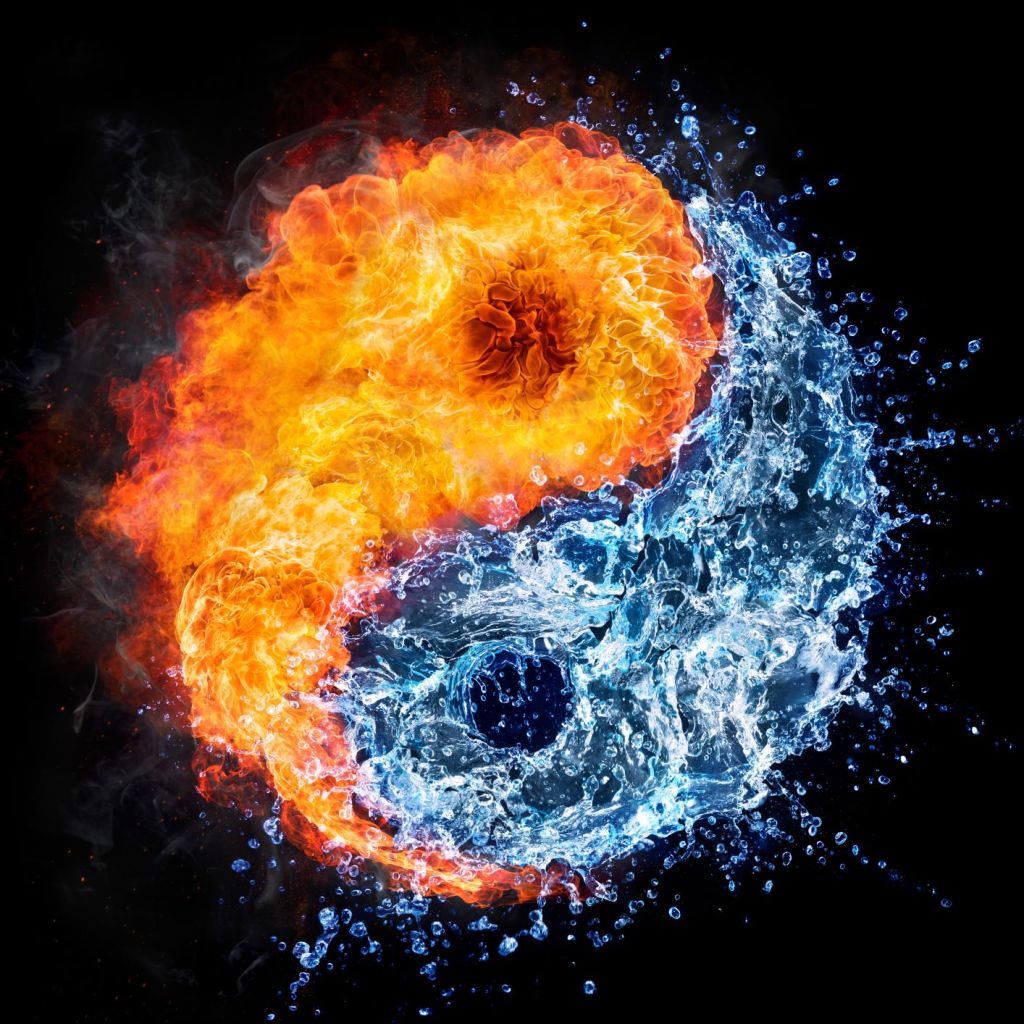
Image: Shutterstock

This is a revised version of an earlier post.

We often experience the world as a struggle between competing opposites: conservative vs liberal, objective vs subjective, male vs female, right brain vs left brain, the inner life vs the outer life, the active vs the passive, and so on.

In the study and practise of Tai Chi I have observed a dynamic tension between opposing forces: advance and withdraw, rise and sink. After many years of diligent practise, you can master the rise without losing the sink or you can withdraw but remain a coiled spring prepared for the advance. Mastering integration ignites explosive power (Tai Chi is a martial art).  It’s not a question of rise or sink, advance or retreat; it’s more a case of rise and sink both happening together so fast as to achieve integration. The interaction of opposites could best be described as a marriage, not a binary choice or a conflict but integration.

A simple practical example will serve to illustrate. First assume a firm stance, left foot forward right foot behind at a 45-degree angle leaving a channel in between. Allow a partner to put his/her hand in the middle of your chest, exerting gradual pressure with a view to pushing you over. Try to stop him/her from pushing you over. The immediate instinctive response is to resist, rise to meet or push back. Note how easy it is to knock you off balance. Now try a different strategy. The more your partner pushes the more you sink into the push, a very counterintuitive response. It might take some practise but you will begin to notice how immoveable you have become. You are relaxing into the push and absorbing the energy of it, ready to give it back.  This is the power which arises from the integration of opposing forces. Alternatively, try pushing on a large tree or telephone pole as hard as you can. Then try it again while sinking into the push and note the difference. The tree or the pole may not budge much, but you can feel the strength in your push; moreover, the results are achieved with much less effort or strain. This accounts for the graceful effortless appearance of Tai Chi when the principles are internalized. Tai Chi integrates non-doing with doing. The Western mind has a hard time with the non-doing part. Chi is the lifeforce energy. The principle is — “energy follows intention.” The masters can exert great power with very little muscular effort by allowing the energy to do the work.  

Practices, like Tai Chi, foster the mind, body, spirit connection. A flexible mind fosters a flexible body and a flexible body fosters a flexible mind in a continuous feedback loop. A flexible mind and body fosters a flexible, open and non-resistant spirit, one open and receptive to an expanded state of consciousness. The Tai Chi philosophy seems to be reflected in the New Testament passage, resist not one who is evil.  The Tai Chi way is nonreactive. A constricted and contracted hose will not allow much water to flow.

Integration is the key but fundamentalists invariably identify with one pole or another creating an adversarial relationship between opposites. The totalitarian strategy of divide and conquer adds fuel to the fire.

From my office window, when spring arrives, I will survey a pleasant scene of forested hills, pastures slowly turning green, and below them, a vast expanse of wetland where ducks and geese are returning from their winter refuge. Soon our farm pond will come alive with tiny goslings and ducklings eagerly following their mothers. It’s a scene of perfect harmony which could not exist without a balance and reconciliation of opposites: death and decay vs renewal and rebirth. Neither should prevail over the other. Both work together for good and what we observe with pleasure is the outcome of integration. Likewise, the most beautiful paintings are a combination of light and dark.

In the latter part of my book, A Prison for the Mind, I identify postmodernism as a fundamentalist belief system, one which has become the prevailing orthodoxy of our time. One of the doctrines of this new religion is that there is no such thing as objective reality. This sets the philosophy on a collision course with Enlightenment principles – a worldview which asserts that there is an objective reality discoverable through reason and the scientific method. Enlightenment principles are summarily dismissed (by the extremists) as the product of a white male patriarchy, a view itself that’s overcome with bias. Here we see the battleground of the subjective (postmodernism) vs the objective (rationality). How can they be reconciled?

I didn’t get too far in my expose of postmodernism before I realized, yes, I too am a postmodernist; I only reject the counterfeit version, used wrongly for political purposes—to foster totalitarianism, censorship and societal subordination to a global technocracy. Nevertheless, we do not understand the world through reason alone and in this sense, I am a postmodernist. We have a left brain which is rational and a right brain which is artistic — the realm of the poet, the mystic, the musician and the painter. A whole person must function with both hemispheres without one dominating the other.

Image: Shutterstock

In the early part of my book, I identify personal experience (subjective) as the only thing we can know for sure and the inner journey as an avenue to certainty (very postmodern). Finding truth in the outer world is difficult because it’s like a carnival funhouse Hall of Mirrors. It’s hard to tell what is real and what is illusion. Observing the outer world, we are confused and unsure, and thus vulnerable to counterfeit offers of comforting certitude.

Here’s where I think the counterfeit version of postmodernism gets it wrong. I refer to a teaching story about a village of blind people trying to figure out what an elephant is. One holds the tail and says it’s a snake. Another holds the leg and says it’s a pillar, another holds the trunk and says it’s a hollow tube; but no one has the vantage point to see the whole elephant even with the use of scientific instruments. The extremists say there is no elephant. I say there is one but difficult to discover (difficult but not impossible). If there was no elephant, then nothing would be objective and therefore nothing in the outer world could be described as true or false. If nothing is true, then science has no place, there would be no such thing as a lie and research would be pointless (i.e., no truth to be found).

You can have your own subjective insights without imposing them on others or using them to ignore verifiable facts or lobbying to have your subjective perceptions enshrined in law. All these things the faux postmodernists attempt. Subjective and objective must walk hand in hand, recognizing their respective spheres of influence. A police officer might follow a hunch or rely on intuition (subjective) to solve a murder but a conviction can only be upheld by evidence gathered and proven in court. Many scientific breakthroughs began as dreams or flashes of insight but these must also be subjected to the rigours of the scientific method.

The great mathematician Ramanujan, from Madras India circa 1915, with almost no formal education, claimed that the Hindu goddess Namagiri would appear in his dreams, delivering mathematical insights, which he would write down when he awoke. He described one of them as follows:

While asleep, I had an unusual experience. There was a red screen formed by flowing blood, as it were. I was observing it. Suddenly a hand began to write on the screen. I became all attention. That hand wrote a number of elliptic integrals. They stuck to my mind. As soon as I woke up, I committed them to writing.”

The Cambridge University mathematician Godfrey H. Hardy, who worked with Ramanujan,  said that if mathematicians were rated on the basis of pure talent on a scale from 0 to 100, he himself would be worth 25, J.E. Littlewood 30, David Hilbert 80, and Srinivasa Ramanujan 100.

When Ramanujan first arrived at Cambridge he insisted that his mathematical insights just came to him or were dictated by God (subjective) but professor Hardy, recognizing his genius, worked with him to provide objective verification based on principles acceptable to the scientific community. This was a very fruitful partnership. The word genius comes from the Latin word of the same name, meaning, “guardian deity or spirit which watches over each person from birth” or “innate ability.”

We become much more effective as a result of integration and the world is more peaceful place without the either-or mindset of fundamentalism.

The amazing life of Ramanujan was made into a feature film, The Man Who Knew Infinity, which I highly recommend. (See Recommended Viewing section for movie trailer.) It is so inspiring to watch the two camps, the logical and the intuitive begin at odds but end in harmony.  Reconciliation of opposites is needed now, more than ever.

(C) Adrian Charles Smith, 2021

Gnosticism & the Divine Feminine

In the early centuries of the Christian era, different attitudes towards sexuality emerged in gnostic and orthodox circles, opening a great gulf between them over what it meant to be a Christian. The orthodox community began to accept the domination of men over women as divinely ordained in social life, family life and in the churches. Orthodox churches accepted as genuine the pseudo-Pauline letters of Timothy, Colossians and Ephesians, where “Paul” insists women are to keep silent in the churches and to remain obedient and submissive to their husbands. In the orthodox gospels, the Saviour ordains Peter to commence an unbroken line of apostolic succession. Jesus says,  “upon this rock (Peter) I will build my church”; but in the gnostic gospels of Phillip and Mary Magdelene, any successor would surely  have  been Mary Magdelene and not Peter; for it was Mary Magdelene who was Jesus’ most intimate companion, one who received from him special teachings. The rest of the disciples, especially Peter, were deeply offended. The Gospel of Phillip reveals the rivalry between the male disciples and Mary Magdelene.

“— the companion of the Saviour is Mary Magdelene. But Christ loved her more than all the disciples and used to kiss her often on her mouth” ; and herein lies, in symbolic terms, the basis of gnostic spirituality, arising as it does from joy, passion, romance, ecstasy, celebration, love and intimacy – the lifeforce itself. In such a setting, doctrinal correctness and obedience to authority cannot inspire or command loyalty. This is why authoritarian structures go to such great lengths to suppress the divine feminine.

For the early orthodox Christian Church, true believers were identified by external criteria, first and foremost – acceptance of Church authority and doctrine. For gnostics, however, Christians were identified by an ecstatic union with the Divine, for which romantic love is but a metaphor. By embarking on the inner journey in solitude, we are introduced to all the world in an amazing correspondence of experience as though each individual, on his own, has tapped the same vast reservoir of gnosis.

George Orwell’s classic work, 1984, reveals the antipathy of all authoritarian structures to the notion of romantic love, which was outlawed in the fictional Oceania where Winston and Julia must conceal their romance, meeting only in secret.

But they were caught and found guilty of “sexcrimes”, which in Newspeak meant the sex act performed with love and passion. The only authorized version was “goodsex”, which meant sex for reproduction only, with no pleasure. After their torture, the lovers could meet openly because they no longer had feelings for each other. They freely discuss their “sexcrimes”, “thought crimes”, and other “treacheries.” No need for the Party to keep them apart any longer. As for Winston, the war with Eurasia was now his main concern. No place at all for his own dreams, like falling in love or fleeing to the country.

This ecstatic union of souls is depicted in the music and poetry of the medieval troubadours. These worshippers of love touched the depths of the collective psyche. The word “troubadour” was derived from the French trovere which meant “to compose” but also “to invent” or “find.” Any instructor of art would want his student, as soon as possible, to sing his own song or write his own poem. The empire, however, does not react well to individual expression.

Mythologist Joseph Campbell writes, “Love was a divine visitation, and that’s why it was superior to marriage. That was the troubadour idea.” Society seeks to manage passion within certain bounds to serve societal purposes, a stabilizing influence with the man as head of the household, his wife and children under control, a microcosm of the empire itself. But true romantic love cannot be managed or contained.

To further emphasize the schism, Sophia, the goddess of wisdom, is central to gnostic mythology, but in the orthodox community, the divine feminine existed only as a weak and watered-down version of both gnostic and pagan mythologies.

According to gnostic myth, Sophia, goddess of wisdom, strays far from the Pleroma (the fullness of God), but without Divine sanction and in the absence of her male consort, the Christ. Sophia cannot help but create, so in her great distress, she gives birth to a flawed, lesser deity, called Yaldabaoth (demiurge), who with the divine light received from his mother, creates material reality, an imperfect refection of the higher realms.  Both Sophia and human beings are now trapped in the false reality of the demiurge and his Archons (rulers).  Sophia herself is embodied in the living earth but the flawed nature of the demiurge is also woven into the fabric of creation. Sophia repents and God takes pity on her by tricking the demiurge to breathing Sophia’s light into the human creation. 

His mother’s divine power left Yaldabaoth. It entered the psychic human body. Yaldabaoth’s demonic forces envied the man. They had given their power to him. His understanding was far greater than that of those who had created him. And greater than that of the chief ruler himself.

(The Secret Book of John, Stevan Davies translation, pages 105-107)

Human beings now have the pivotal role in Sophia’s restoration.                                                                                                                                                                                                                            

Gnostic scholar, Dr Joanna Kujawa (visit Recommended Viewing/Reading) encourages restoration of the divine feminine as essential to escaping the false reality of the demiurge. Mary Magdelene is yet another version of Sophia, as are the ancient goddesses, Inanna, Isis, Ishtar and Persephone. According to Dr Kujawa, all these goddesses are portals between life and death, ignorance and gnosis. We see, for example, Mary Magdelene present at the tomb of Jesus, co-incident with his resurrection. The feminine is our portal into this world and our portal between this world and the next. Sophia is the goddess of resurrection which, metaphorically, includes the transformation of consciousness while we are alive. That transformation takes place through an expansion of consciousness, not possible when operating with the left-brained, male-dominated, linear mind alone. The linear mind is perfect at organizing life on the material plane – building hierarchies, empires, bridges, spaceships; crucial to the work of police detectives, paramedics, plane crash investigators and when arguing in court. But it can be inflexible, fear-based, contracted, limited in vision, clinging to the status quo; and preferring the hard nosed “desert of the real” to the fluidity and uncertainty of the transcendent. The divine feminine, by contrast, is based on love, intuition, comfort, joy and when “perfect love casts out fear”, we are free at last from the confines of our mental prison.

A contracted fear-based consciousness perceives a world which really is not there. An expanded open consciousness will see “a new heavens and a new earth” which was always there but not perceived.  It is the goddess which will cleanse the doors of our perception.

This is confirmed in the gnostic texts and reiterated by the romantic poets.

The kingdom of the Father is spread out upon the earth, but you do not see it (Gospel of Thomas)

According to the Secret Book of John, “human beings erroneously believe they are embedded in a material world when in fact they are spiritual beings, and the material world is not really there at all.”

 (Stephan Davies Annotation page 106)

Likewise, the poet Wordsworth, recalls his early childhood bliss but laments the gradual loss of an elevated level of perception.

There was a time when meadow, grove and stream the earth, and every common sight, to me did seem apparelled in celestial light, the glory and freshness of a dream”

These early childhood memories of the celestial realms are soon crowded out by the cares of this world.

“Heaven lies about us in our infancy! Shades of the prison-house begin to close upon the growing boy.”

(Ode: Intimations of Immortality from Recollections of Early Childhood By William Wordsworth)

By contrast, another of the romantics, William Blake, sees the work of the demiurge in nature.

Tyger Tyger, burning bright, 
In the forests of the night; 
What immortal hand or eye, 
Could frame thy fearful symmetry?

What the hammer? what the chain, 
In what furnace was thy brain?
What the anvil? what dread grasp, 
Dare its deadly terrors clasp! 

When the stars threw down their spears 
And water’d heaven with their tears: 
Did he smile his work to see?
Did he who made the Lamb make thee?
(The Tyger by William Blake)

Nevertheless, in The Marriage of Heaven and Hell, he also emphasizes our perceptual limitations.

“If the doors of perception were cleansed everything would appear to man as it is, Infinite. For man has closed himself up, till he sees all things thro’ narrow chinks of his cavern.”

(William Blake, The Marriage of Heaven and Hell)      

This is reminiscent of Plato’s cave dwellers, sitting with their backs to the cave entrance, seeing only shadows on the wall and mistaking this for reality.

A few years ago, I had a powerful dream more significant to me now than it was then. It was one of those dreams, more real than real with an enduring impact. I am paddling my kayak along canals in what appears to be an ancient city. The water is still and calm, the canals are straight, meeting at right angles. The buildings are imposing, made of large granite blocks and tall Corinthian columns. But there are no people around and the environment feels sterile. I make a turn into one canal where the water is flowing, albeit slowly. Soon the scene changes dramatically, as I battle a raging torrent in a breathtaking natural environment. Everything around me is now alive, wild water and towering waves, forest, fields and mountains; but I am very afraid.  Soon, however, I feel a strong reassurance that I cannot die, and this allows me to go with the flow. Fear turns into exhilaration as the waters form a luminous blue and white tunnel all around me. At the end of the tunnel is a bright light.

Could this have been the goddess opening a portal and providing the comfort and re-assurance to enter it?  In retrospect, I think so, and this was her message – trust, allow and surrender.

(C) Adrian C. Smith 2020

Hermeticism and the Transformation of Consciousness

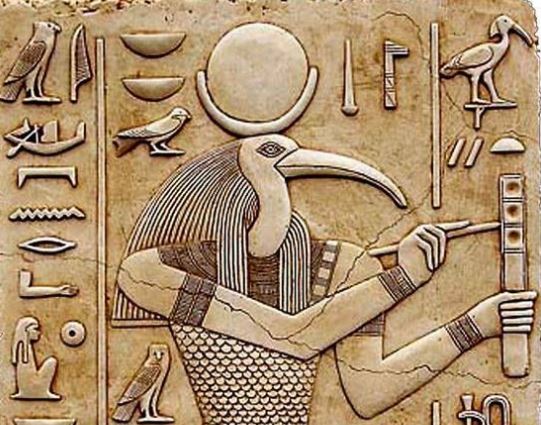
Egyptian God Thoth

In Hermetic tradition, the Egyptian God Thoth, the Ibis-headed god with a writing implement in his hand, was considered the font of all wisdom; a man-god revealing to the Egyptians their knowledge of astronomy, architecture, geometry, medicine and religion. From this advanced knowledge, wonders emerged, such as the Great Pyramid of Giza. The Greek name for Thoth is Hermes, otherwise known as Hermes Trismegistus, the “Thrice Great Hermes”, the greatest of all priests, the greatest of all philosophers and the greatest of all kings.

The Egyptians were not materialists, so spiritual understandings and principles were not excluded from their science. Therefore, chemistry blended into alchemy, the notion that anything could be transformed, including consciousness.

The Principle of Mentalism, central to Hermeticism, embodies the idea that “All is Mind.” Everything that happens arises from a preceding mental state. For anything to exist, thoughts had to form first, which then manifest as physical reality. This ancient concept is confirmed by some of the most famous modern physicists.

Physicist Max Planck said, “All matter originates and exists only by virtue of a force —. We must assume behind this force the existence of a conscious and intelligent mind. This mind is the matrix of all matter.”

Planck, the originator of quantum theory, received the Nobel Prize for physics in 1918.

Cambridge physicist, Sir Arthur Eddington,  wrote, “The universe is of the nature of a thought or sensation in a universal Mind … To put the conclusion crudely — the stuff of the world is mindstuff.”

During WW1 Sir Arthur collaborated with Albert Einstein to prove Einstein’s new theory on gravity. This was made into an excellent film, Einstein and Eddington. (I have posted a link in the Recommended section.) Eddington was renowned for his ability to explain relativity in understandable terms, and his lectures on this topic were compiled in a book, The Mathematical Theory of Relativity, which Albert Einstein suggested was “the finest presentation of the subject in any language.”

Albert Einstein himself, as well as Stephen Hawking, have described science as an attempt to understand the mind of God.

Copernicus made his momentous claim that the sun, not the earth, was the centre of our solar system, after studying hermeticism.

The Principle of Mentalism is the first of seven Hermetic principles. “The All is Mind; the Universe is Mental”, The Kybalion (a hermetic manuscript). Implicit in this view is the notion that the material world, including our compulsions, addictions, moods and attitudes, is plastic to our thought.  Human beings, viewed as individual holographic expressions of an all-encompassing Mind, may have more influence over ourselves and over the world than we can possibly imagine.

This brings us to the Sixth Hermetic Principle, the Principle of Cause and Effect.  The world, and our reaction to it, are the effects of thinking. Can we move mountains with our thinking?

In The Matrix, Neo asks Morpheus, “What are you trying to tell me? That I can dodge bullets?” Morpheus replies, “No Neo, I’m trying to tell you that when you’re ready, you won’t have to.” Perhaps we are ready once we realize who we truly are — an aspect or fragment of the Divine.

But the prevailing philosophy of determinism says that we have no choice, that we are victims of circumstances, mere pawns in the game of life, that our choice is an illusion; but the Hermeticists, rising to the plane above, learned to master their moods, compulsions, obsessions as well as the world around them by operating from a higher plane of existence, rising above what appears to be a deterministic prison. They became players, rather than being played by their internalized demiurge or tossed to and fro by the will and intentions of others.

Change your thinking and change your world. Sounds easy but we all know it is not. The transmutation of base metal into gold, an allegory for mental mastery, is not easy but still possible.

Psychiatrist Victor Frankl, author of Man’s Search For Meaning, was a holocaust survivor. His story tells us we might not always dodge the bullet, but we can still retain mental mastery. He did not dodge the bullet when he lost everything in the camp. In the camp everything was taken away, except one thing, the power to choose one’s mental state. He chose to find meaning in the completion of an academic paper and this act of will saved his life. He did not dodge the bullet but, in the end, he did not have to. He survived to find out “that which does not kill us makes us stronger” (Nietzsche); yet he has the humility to admit, “the best of us did not survive”. 

On one occasion when I was discouraged about something, I picked up a book to see if I could find some words to make me feel better (a very crude from of divination). My eyes immediately fell upon a verse from Milton’s Paradise Lost: “The mind is its own place, and in itself can make a heaven of hell, a hell of heaven.”

If Victor Frankl could find meaning in Auschwitz, why then is there misery in mansions? The answer lies in the power of the mind to create within itself a heaven or a hell and to do so regardless of external circumstances.

The passage had quite an impact. After a while I put the book down and turned on the television. At that precise moment, someone was reading that very passage. Another of those astonishing synchronicities Jung wrote about, meaningful co-incidences in a meaningless world. In a meaningless world, we cancel the deficit of meaning by rising to the higher planes (pleroma) of our transcendent mental capabilities.

(c) Adrian Charles Smith 2020